
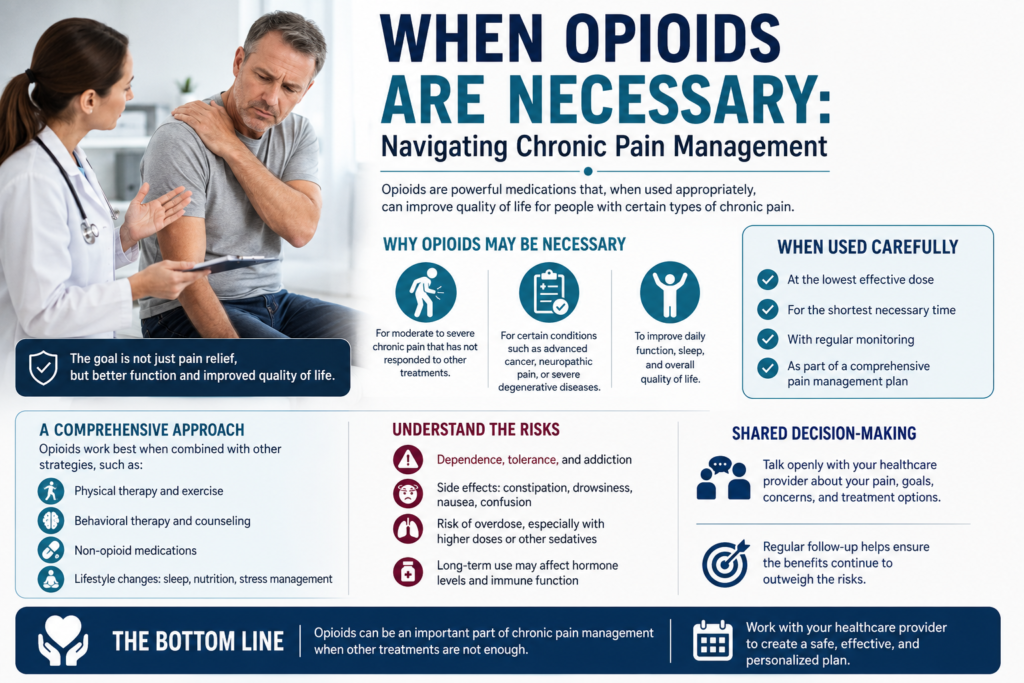
Introduction: The Opioid Dilemma in Chronic Pain
Chronic pain affects millions of Americans, and for many, finding effective relief is a daily struggle. Opioid medications are powerful tools in the pain management arsenal, but their use is fraught with risks. The Centers for Disease Control and Prevention (CDC) emphasizes that nonpharmacologic therapy and nonopioid pharmacologic therapy are preferred for chronic pain . However, there is still a role for opioids when used appropriately, in the right patients, and with careful monitoring. This guide explores when opioids are necessary for chronic pain management, how to navigate the risks, and the importance of a patient-centered approach. For more information on prescription medications for pain management, visit our website.
The CDC guideline calls on physicians to avoid increasing opioid dosage to 90 morphine milligram equivalents (MME) or more, and to limit opioids for acute pain to three to five days .
When Are Opioids Appropriate?
Opioids are not a first-line treatment for chronic pain. According to the CDC, clinicians should consider opioid therapy only if expected benefits for both pain and function are anticipated to outweigh risks to the patient . They should be considered when non-opioid options have failed or are contraindicated.
Assessing Benefits vs. Risks
Appropriate Indications for Opioid Use
- Acute Pain: Severe acute pain from trauma, major surgery, or other conditions where NSAIDs are ineffective or contraindicated . The CDC recommends prescribing the lowest effective dose for no more than 3-7 days .
- Chronic Pain with Documented Benefit: For some patients with chronic non-cancer pain, opioids may provide clinically meaningful improvement in pain and function that outweighs risks . This requires careful patient selection and monitoring.
- End-of-Life and Palliative Care: For patients with serious illness or a poor prognosis, the benefits of opioids for pain relief often outweigh the risks .
The Japan Society of Pain Clinicians emphasizes patient selection for opioid therapy, including an obvious organic cause of pain, low risk of psychosocial factors, pain refractory to non-opioid therapies, and good adherence to medication .
Risks of Opioid Therapy
The use of opioids is associated with significant risks that must be carefully weighed against potential benefits. Even when used as prescribed, long-term opioid therapy carries risks of dependence, tolerance, and addiction .
Addiction, Respiratory Depression, and More
Key Risks to Consider
- Addiction, Abuse, and Misuse: Opioids have a high potential for addiction, which can lead to overdose and death .
- Life-Threatening Respiratory Depression: This is a serious and potentially fatal risk, particularly during initiation of therapy or following dose increases .
- Serotonin Syndrome: Some opioids, including tramadol and oxycodone, can affect serotonin kinetics and should be used cautiously with other serotonergic agents .
- Lack of Long-Term Efficacy: The American Academy of Neurology position paper concluded that “there is no substantial evidence of pain relief or improved function over long periods of time without incurring serious risk of overdose, dependence, or addiction” .
- Cardiac Risks: A meta-analysis found that tramadol likely increases the risk of serious side effects, including cardiac events such as chest pain, coronary artery disease, and congestive heart failure .
Best Practices for Opioid Prescribing
When opioids are deemed necessary, following best practices can help maximize benefits and minimize risks. The CDC provides clear recommendations for safe prescribing .
Safe Dosing, Monitoring, and Tapering
Guidelines for Safe Opioid Use
- Use Immediate-Release Formulations: When starting opioid therapy, prescribe immediate-release opioids instead of extended-release or long-acting (ER/LA) opioids .
- Start with the Lowest Effective Dose: Prescribe the lowest effective dosage and use caution when considering increasing dosage to ≥50 MME/day. Avoid increasing to ≥90 MME/day .
- Limit Duration for Acute Pain: For acute pain, prescribe no greater quantity than needed for the expected duration of pain. Three days or less will often be sufficient; more than seven days will rarely be needed .
- Monitor Regularly: Evaluate benefits and harms with patients within 1-4 weeks of starting opioid therapy or of dose escalation, and every 3 months thereafter .
- Have an “Exit Strategy”: Consider how opioid therapy will be discontinued if benefits do not outweigh risks .
Tapering and Discontinuation
If the risks of opioid therapy outweigh the benefits, clinicians should work with patients to taper opioids to lower dosages or to discontinue them . A gradual taper is essential to avoid withdrawal symptoms and potential harm.
Reasons for Tapering
- Lack of clinically meaningful improvement in pain and function
- Occurrence of serious adverse events or side effects
- Signs of opioid misuse or addiction
- Patient request
Pain clinical specialists emphasize a multidisciplinary approach to opioid management, involving personalized treatment plans, enhanced clinician training, and patient education programs .
Conclusion
Opioids have a role in chronic pain management, but they are not a panacea. They should be used judiciously, with careful patient selection, clear treatment goals, and regular monitoring. The evolving landscape of opioid prescribing emphasizes the importance of multimodal pain management, combining non-opioid medications, physical therapy, and behavioral interventions. Patients and providers must work together to navigate the complexities of chronic pain, balancing the need for relief with the imperative for safety.
Frequently Asked Questions
🔗 Explore More Resources
Visit Justin Healthcare for more information on:
📚 External Resources
For authoritative information on pain management and opioid safety, visit: